
April Concert 2026
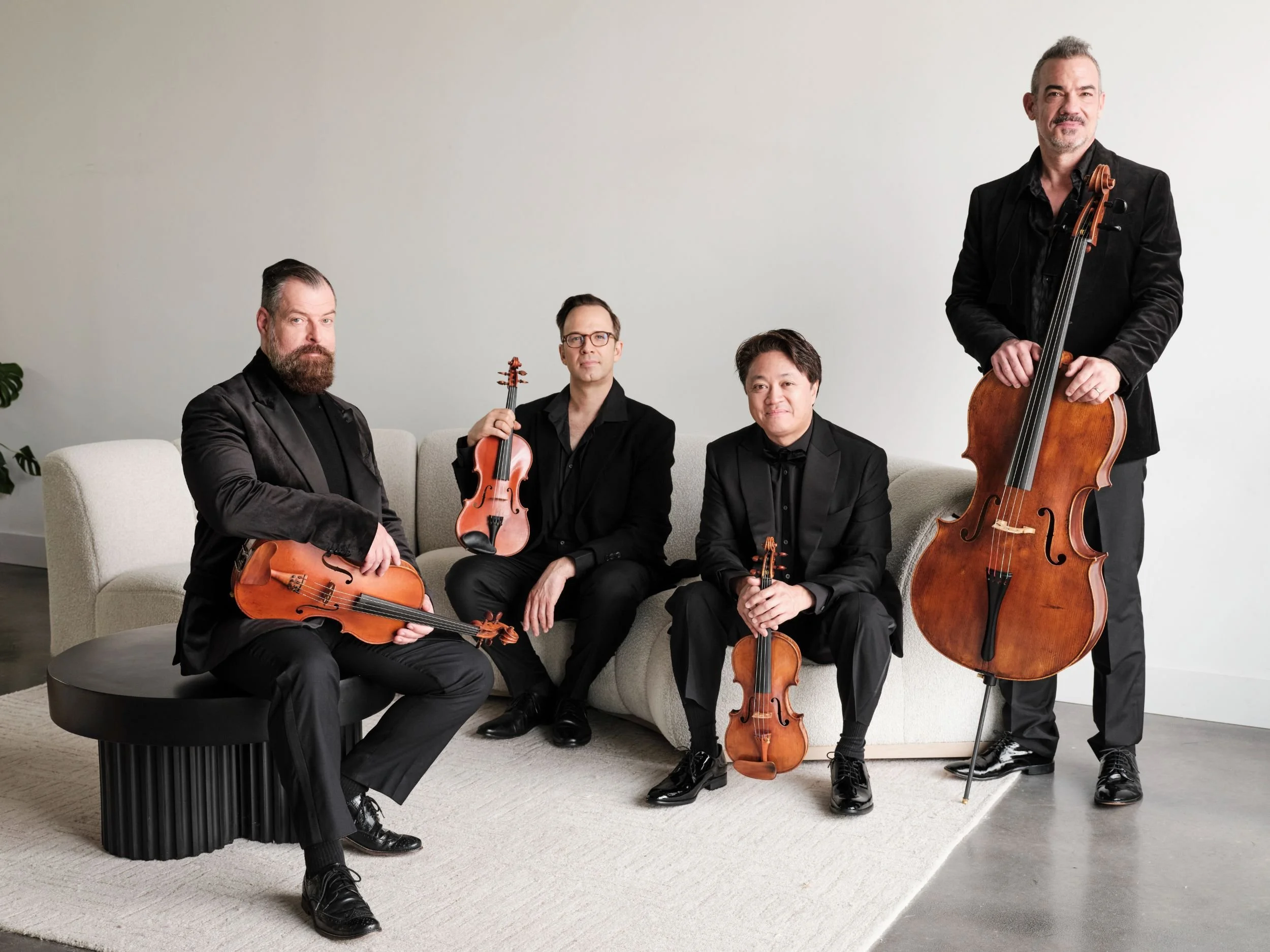
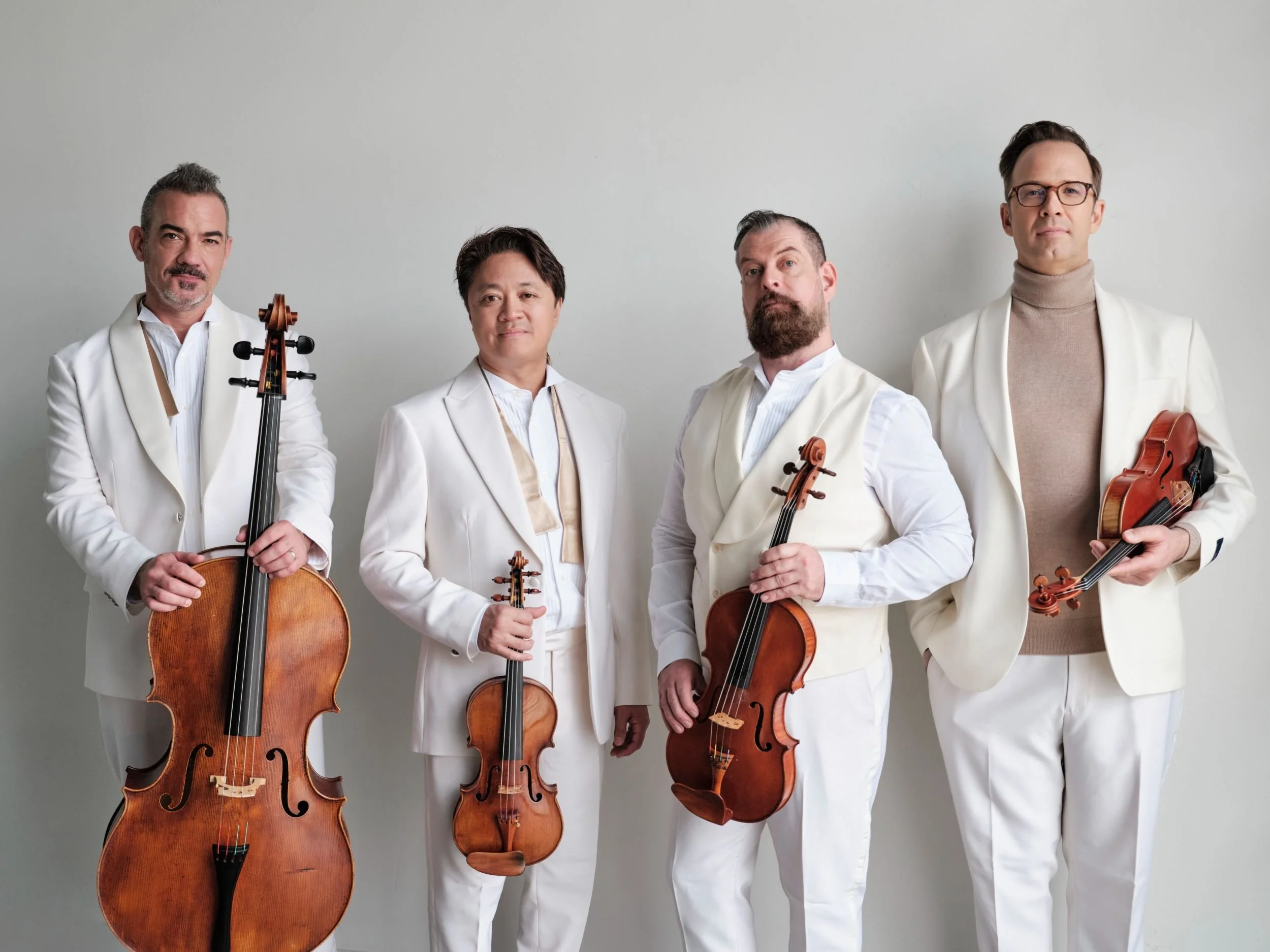
The Miró Quartet
One performance only! saturday, april 4, 2026 at 4:00 pm
(Doors open at 3:30 pm)
The Miró Quartet returns to Salon Concerts in April to play outstanding pieces of the string quartet literature. Enjoy fine wines, delicious food and a chance to meet the artists.
Artists:
Daniel Ching, Violin
William Fedkenheuer, Violin
John Largess, Viola
Joshua Gindele, Cello
Program:
String Quartet, Op. 18, No. 6 (IV) ………………………………………………… Ludwig van Beethoven
Rhythmic drive, quick exchanges among the instruments, and dramatic contrasts of dynamics and key create an atmosphere of youthful brilliance in this Quartet. At once elegant and bold, this movement reflects Beethoven’s early mastery of the string quartet and hints at the originality to come.
Blueprint …………………………………………………………………………………… Caroline Shaw
Born in 1982, Caroline Adelaide Shaw is an American composer of contemporary classical music, violinist, and singer. She won the 2013 Pulitzer Prize for Music for her a cappella piece Partita for 8 Voices. She describes herself as a musician who moves among roles, genres, and mediums, trying to imagine a world of sound that has never been heard before but has always existed. She works often in collaboration with others, as producer, composer, violinist, and vocalist. Caroline is the recipient of the Pulitzer Prize in Music, several Grammys, and an honorary doctorate from Yale. Her favorite color is yellow, and her favorite smell is rosemary. Blueprint for string quartet is the perfect piece to follow Beethoven’s Op. 18, No. 6.
Ainsi la nuit IV, V, VI ……………………………………………………………………… Henri Dutilleux
Henri Dutilleux’s Ainsi la nuit (“Thus the Night”) is one of the 20th century’s most important string quartets, composed between 1973 and 1976 and commissioned by the Koussevitzky Foundation for the Juilliard Quartet. Dutilleux conceived the work as a single arc in seven short movements, linked by “parenthetical” passages that recall earlier material and anticipate what is to come. The result is a piece less about linear progression than about shifting perspectives, as if the listener were exploring facets of a nocturnal landscape.
The middle section of the quartet, movements IV–VI, forms its emotional core. These movements highlight Dutilleux’s refined harmonic palette and sensitivity to sound color, offering a vision of night that is both urgent and mysterious, intimate and cosmic.
String Quartet, Op. 71, No. 2, II, III …….………………………………………………… Joseph Haydn
By the early 1790s, Joseph Haydn was Europe’s most celebrated composer of string quartets, admired for elevating the genre to a model of balance, dialogue, and expressive depth. The quartets of Op. 71 were written for his second London visit (1794–95), where they were designed for public concert performance rather than the intimate salon. Their bold openings and theatrical gestures reflect this new context.
The second movement, Adagio, offers a striking contrast to the energetic first movement. In B-flat Major, it is an expansive, songful meditation whose long-breathed melody unfolds with grace and poise. The quartet texture is notably lyrical, with the first violin often in a cantabile role while the lower strings provide delicate support, giving the music the character of a heartfelt aria.
The third movement, Menuetto: Allegretto, returns to D Major with rhythmic vigor and good humor. Together, these movements exemplify Haydn’s ability to balance elegance, wit, and emotional depth within the quartet form.
String Quartet, Op. 10 …………………………………………………………………… Claude Debussy
In 1893, Debussy composed his first important work, the String Quartet in G minor, Op. 10. It was the only work to which he attached an opus number or a key designation and it was the only work Debussy wrote in a conventional form. Outwardly, the quartet assumes the mold of a traditional string quartet comprising four movements: a first movement sonata, a rhythmic scherzo, a slow, lyrical movement and an energetic finale. But within this unremarkable template, the music sounds completely new. Debussy expanded the sound of the string quartet with a variety of novel textures and tonal effects ranging from delicate subtlety to ravishing grandeur. With exotic scales, unconventional chords, progressions and key changes, the music features melodies and harmonies unique for their time. Especially striking is the quartet's rhythmic vitality, spontaneous agility and poetic subtlety. With swiftly changing tempi, a wealth of dazzling figurations, cross-rhythms and the special shimmering or hovering pulsations typical of his music, Debussy captures a nuanced experience of time.
THE MIRÓ QUARTET
The Miró Quartet is one of America’s most celebrated string quartets, praised as "furiously committed" by The New Yorker and recognized for its "exceptional tonal focus and interpretive intensity" by the Cleveland Plain Dealer. For nearly 30 years, the GRAMMY®-nominated quartet has performed on the world’s most prestigious concert stages, earning accolades from critics and audiences alike. Based in Austin, TX, and thriving on the area’s storied music scene, the Miró takes pride in finding new ways to communicate with audiences of all backgrounds while cultivating the longstanding tradition of chamber music. Miró Quartet’s recent and upcoming projects include a touring and recording project with pianist Lara Downes titled Here on Earth, featuring musical depictions of our planet, its evolution, and the lives of its inhabitants; the premiere of a new version of Kevin Puts’ Credo with the Naples Philharmonic; and collaborations with composers Steven Banks, Tamar-Kali, and Gabriel Kahane, as well as soprano Karen Slack. Having independently released many celebrated recordings for a variety of global labels, the Miró Quartet was nominated for a 2025 GRAMMY® Award for Best Chamber Music/Small Ensemble Performance for its second album on Pentatone, Home, featuring two new commissions by Kevin Puts and Caroline Shaw, as well as works by George Walker and Samuel Barber.
It was nominated for a 2024 GRAMMY® Award for Best Choral Performance for House of Belonging, created in collaboration with Austin-based choral group Conspirare. The quartet recently produced an Emmy Award-winning audiovisual multimedia project titled Transcendence, a documentary centered around a performance of Franz Schubert’s Quartet in G Major on rare Stradivarius instruments, available on livestream, CD, and Blu-ray. Formed in 1995, the Miró Quartet was awarded first prize at several national and international competitions including the Banff International String Quartet Competition and the Naumburg Chamber Music Competition. Deeply committed to music education, members of the Quartet have given master classes at universities and conservatories throughout the world, and since 2003 has served as the quartet-in-residence at the University of Texas at Austin Sarah and Ernest Butler School of Music. In 2005, the Quartet became the first ensemble ever to be awarded the coveted Avery Fisher Career Grant. The Miró Quartet took its name and its inspiration from the Spanish artist Joan Miró, whose Surrealist works — with subject matter drawn from the realm of memory, dreams, and imaginative fantasy — are some of the most groundbreaking, influential, and admired of the 20th century.