
OCTOBER Concert 2026
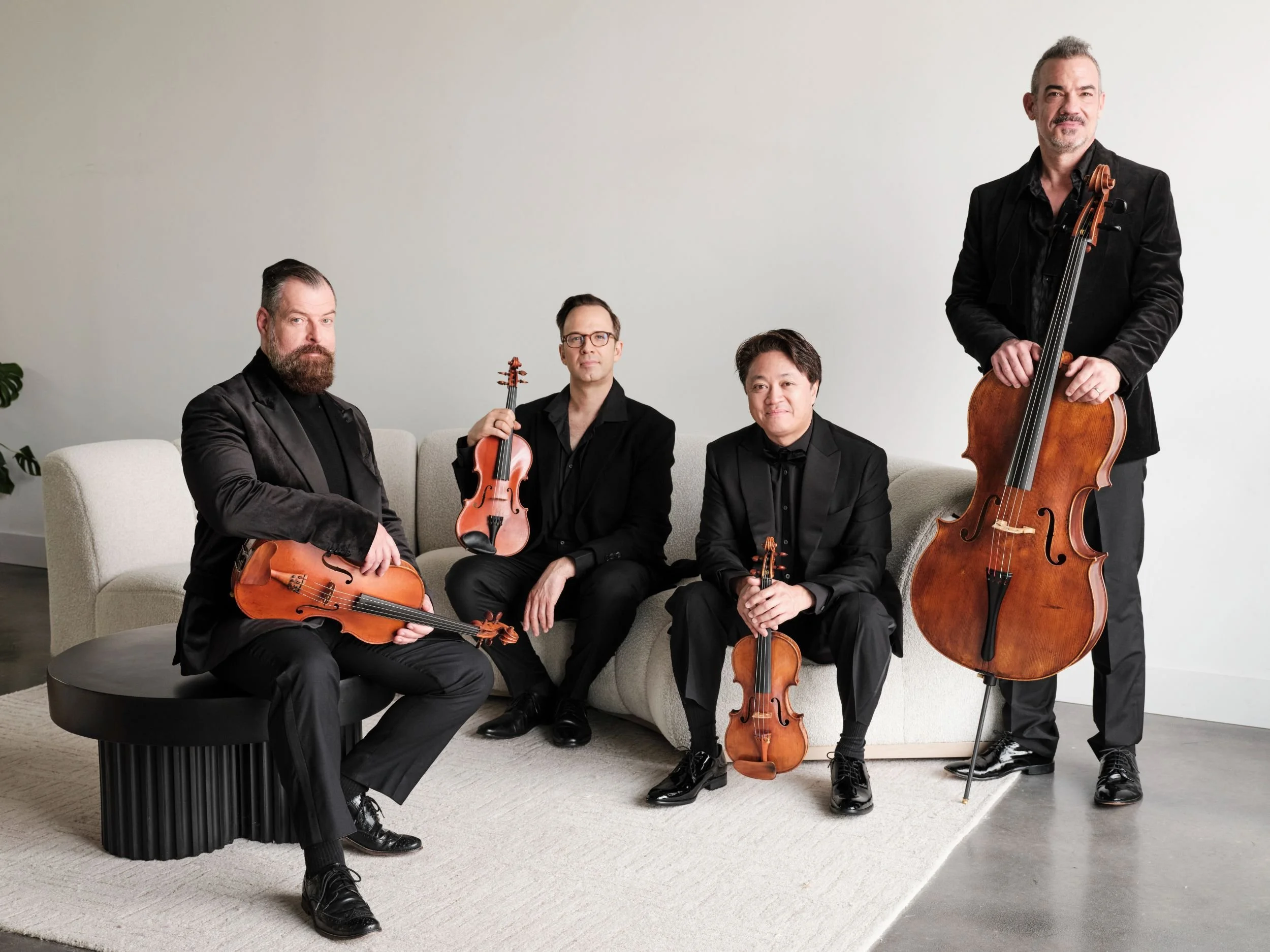
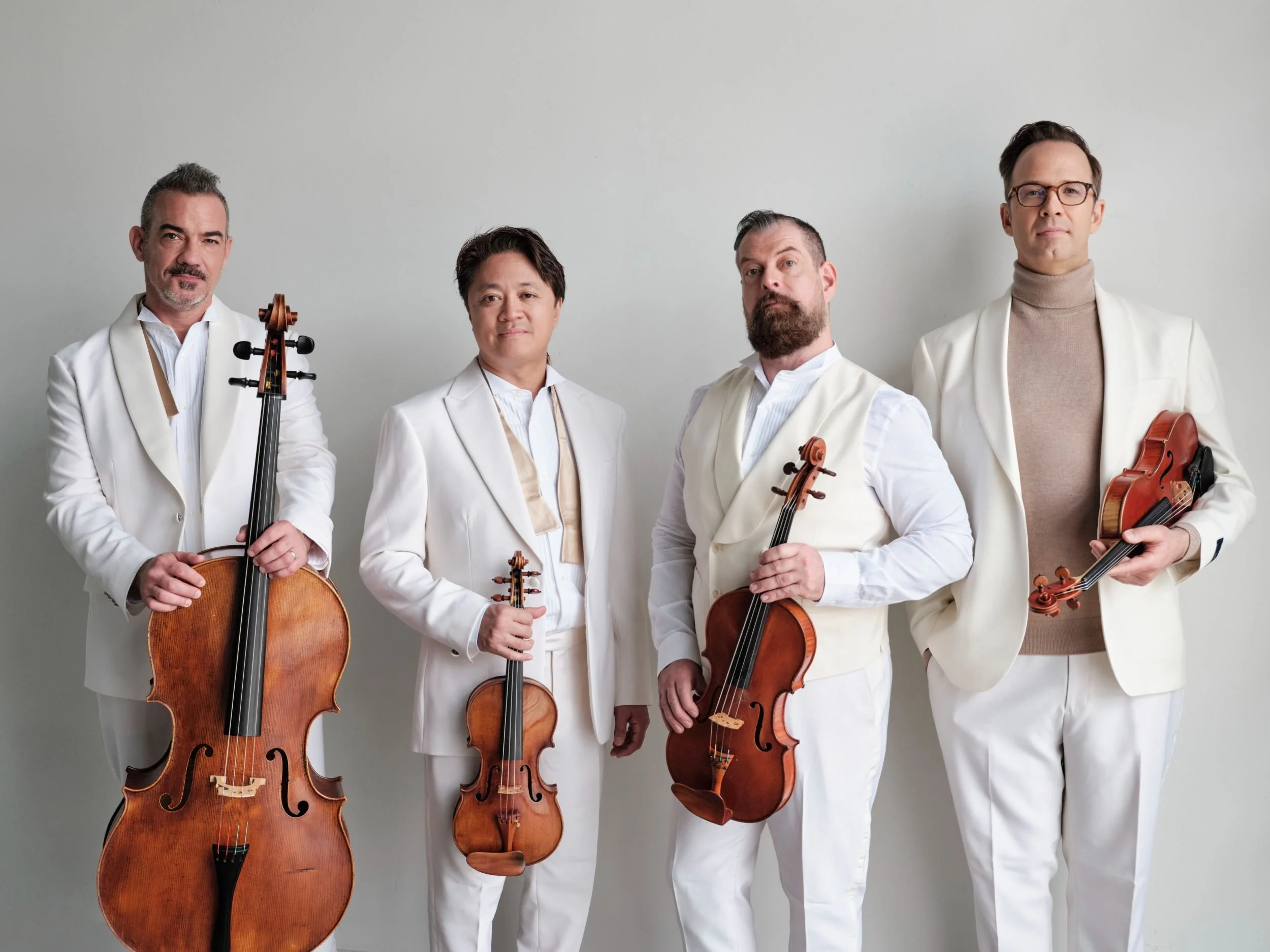
Miró Quartet
One performance only! SUNDAY, OCTOBER 18, 2026 at 4:00 pm
(Doors open at 3:30 pm)
The Miró Quartet returns to Salon Concerts in October to play outstanding pieces of the string quartet literature. Enjoy fine wines, delicious food and a chance to meet the artists.
Artists:
Daniel Ching, Violin
William Fedkenheuer, Violin
John Largess, Viola
Joshua Gindele, Cello
Program:
Quartet in C minor, D. 703, “Quartettsatz” . Franz Schubert
Langsamer Satz . Anton Webern
String Quartet in G major, D. 887 . Franz Schubert
Franz Schubert (1797–1828)
Quartet in C minor, D. 703, “Quartettsatz”
Franz Schubert wrote at least 17 works for string quartet, the bulk of which he composed for the practical purpose of playing chamber music at home with his family. These earlier works, designed for his father, brothers and himself, are skillful, winning and, due to the technical limitations of his family members, suitable for amateur players. This all changed with the so-called “Quartettsatz” (a posthumously applied title meaning “quartet movement”) of 1820 written when Schubert was in his early 20s.
His 12th string quartet, the “Quartettsatz” is often regarded as the first of Schubert’s mature works inaugurating a series of four final quartets that are unique masterpieces of the genre. While the last three are all substantial works in the Classical four-movement template, the “Quartettsatz”, as its nickname implies, is but a single movement. Schubert apparently intended to write more but, for reasons unknown, completed the first movement and only part of a second before abandoning the unfinished quartet. It is a “torso”, but much like the unfinished symphony with which it has much in common, the “Quartettsatz” is celebrated for its achievement and today it proudly stands alone, complete unto itself. In strong contrast to the previous quartets, Schubert reveals the full technical and dramatic means of his mature style with his signature contrasts between dark, impetuous agitation and ineffably sublime lyricism.
Characteristic of Schubert, the shifts in theme and mood are accompanied by unusual and affecting key changes for music that is a vividly charged amalgam of restlessness and serenity. Lying fallow until long after his death, the manuscript eventually came into the hands of Brahms who edited and published the quartet in 1870.
© Kai Christiansen Used by permission. All rights reserved.
Anton Webern (1883-1945)
Langsamer Satz [Slow Movement], mit bewegtem Ausdruck, 1905
Langsamer Satz is a highly charged work, clearly rooted in post-Brahmsian romanticism and tonality. It expresses a plethora of emotions from yearning to dramatic turmoil to a tranquil peaceful denouement. It shows that Webern, like Schönberg and Berg, was capable of writing very fine music in a tonal idiom if he chose. This work is a little masterpiece.
Franz Schubert
String Quartet No.15 in G Major, Op.161 (D887)
I. Allegro molto moderato
II. Andante un poco moto
III. Scherzo. Allegro vivace-Trio. Allegretto
IV. Allegro assai
Schubert wrote his final string quartet during a period of ten days in 1826, around the same time that Beethoven finished his own late essays in the genre. Schubert, a long-time admirer of Beethoven, would be a bereft torch bearer at Beethoven's funeral in 1827, just one and a half years before Schubert's own death in 1828.
The String Quartet in G Major is chamber music on a massive scale. Within the first few measures, Schubert establishes his familiar dichotomy between light and dark as a G Major chord transforms simply, suddenly, and significantly into G minor. This mercurial and fundamental battle between light and dark rages on until the very end of the quartet, some fifty minutes later. Schubert's arresting introduction soon softens into floating light with a telltale signature: a quiet, fluttering tremolo of quick triplets punctuated by a germinal motif fragment in a dotted rhythm. With a steep rise in dynamics and the fully marshaled force of the ensemble, the introduction morphs into the primary thematic material that will course throughout the movement in continuous alteration with a second lyrical theme soon to come. In a unique approach to sonata form, Schubert seems to co-evolve both theme areas in successive waves as each interrupts the other while internally growing more elaborate. It is not until the last few bars that the battle finally yields to a briefly stable victory for G Major.
Schubert concludes his final string quartet with the perpetual motion of a sonata rondo in a typical 6/8 meter at a brisk clip, for the most part a high-spirited dance. Characteristically, the first several measures feature an unstable tonality flickering by the beat between major and minor and just as quickly, restless modulations to new keys. Many commentators have likened the finale to an opera buffa where Schubert's temperamental drama assumes a comedic cast in a kind of frantic parody of itself. The combination of reprise along with prominent developmental aspects crafts a hybrid of rondo and sonata forms, first established by Haydn. The comparatively effervescent character of Schubert's conclusion is merely a pause in the seemingly endless flow of his mightier passions.
Excerpted from © Kai Christiansen Used by permission. All rights reserved.